
SEAI Exclusive: Southeast Asia Confronts a New and Uncertain Geoeconomic Era: What do the Region’s Agreements on Reciprocal Tariffs (ARTs) tell us?
Publication date/year: 7 May 2026
Author: Helen E.S. Nesadurai is Professor of International Political Economy at Monash University
Malaysia.
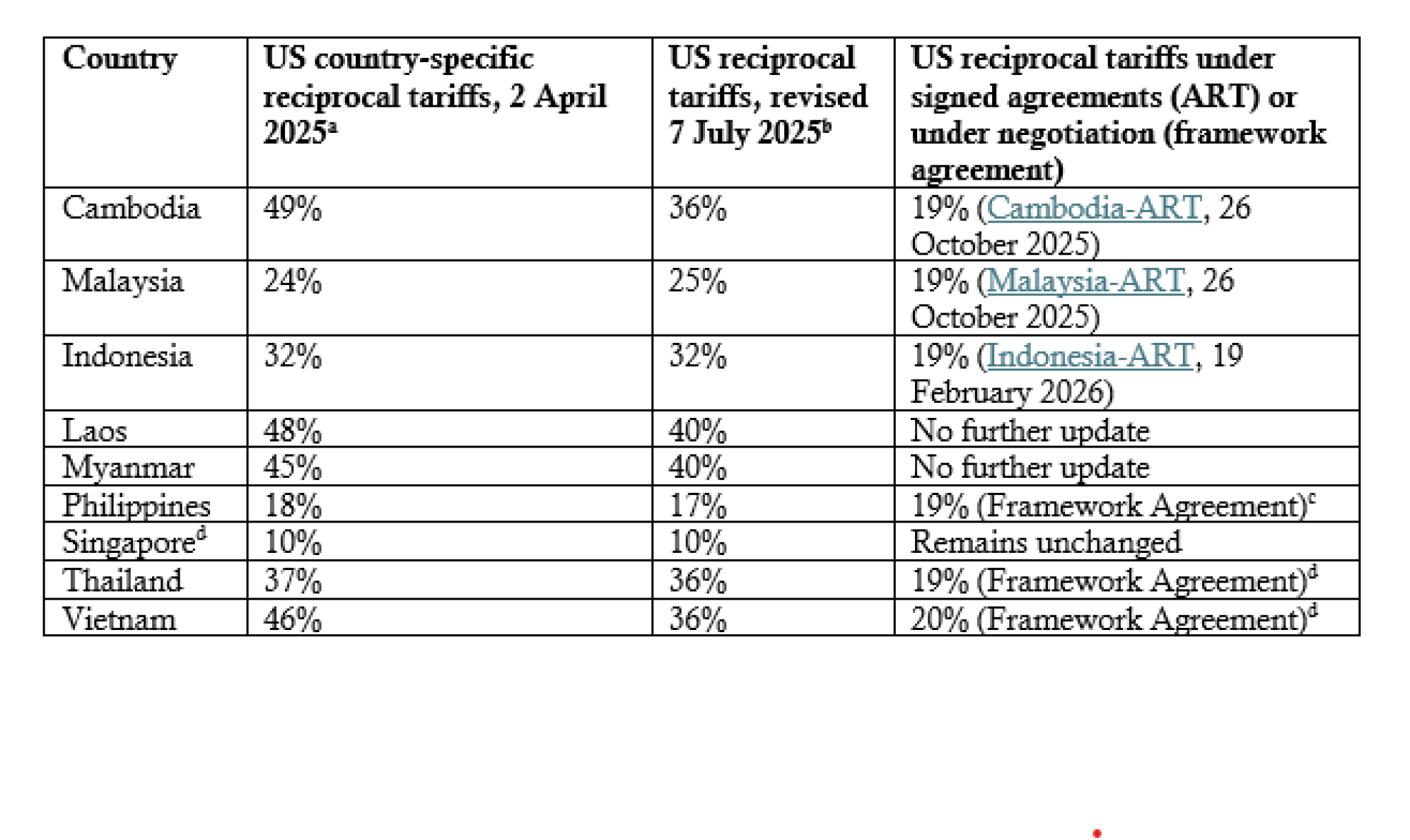
On 2 April 2025, hailed by President Trump as “Liberation Day”, the United States (US) government introduced unprecedented “reciprocal tariffs” on a swathe of countries around the world, Southeast Asia included, as part of its “America First” trade policy. Revised several times over the course of 2025, as outlined in Table 1, these unilaterally imposed tariffs served as a stick to bring Washington’s trading partners to the negotiating table, at which Washington held considerable sway. From these negotiations, three Agreements on Reciprocal Tariffs (ARTs) have been signed involving Southeast Asian countries – US-Malaysia, US-Cambodia, and US-Indonesia – at substantially lower tariff rates than Washington had previously applied, much to the relief of these governments.
Table 1: Reciprocal tariffs on Southeast Asian countries, key milestones since April 2025
Source: Author’s compilation from following sources:
a: https://www.csis.org/analysis/liberation-day-tariffs-explained, 3 April 2025.
b: https://cariasean.org/news/cari-captures-issue-711-trump-announces-new-series-of-tariffs-on-asean-countries-effective-01-august/, 1 August 2025.
c: https://edition.cnn.com/2025/07/22/business/trump-philippines-trade-deal, 22 July 2025.
d: https://www.channelnewsasia.com/asia/southeast-asia-tariff-trump-us-supreme-court-5952201, 26 February 2026.
Uncertainty, however, returned when the US Supreme Court handed down its majority decision on 20 February 2026 that President Trump could not legally authorise open-ended tariffs on the rest of the world using the International Emergency Economic Powers Act but could use other available trade policy instruments. The president immediately announced 10% tariffs on all countries, later raising those to the 15% maximum permitted by the 1974 US Trade Act, specifically Section 122, which allows for across-the-board tariffs to be applied for 150 days, renewable by Congress, to address “large and serious balance-of-payments deficits”. However, these too face potential lawsuits as to the legality of invoking Section 122. The US has now turned to launching investigations on unfair trade practices in order to apply tariffs on its trading partners using Section 301 of the 1974 US Trade Act.
In this updated commentary, I draw out from the three already-signed ARTs their underlying dynamics to offer some thoughts on what these agreements and subsequent US response to the Supreme Court decision reveal about the challenges of economic security in Southeast Asia as Washington pushes to remake the global economic order to favour US economic dominance amidst strategic competition from China. With economic resilience especially significant in the current era of geopolitical uncertainties and risks, these underlying US dynamics are likely to impact on the Southeast Asian economic security model rooted in open markets and integration into global supply chains. In this regard, three features common to the three ARTs are especially salient.
First, while tariffs were reduced from the arbitrarily imposed ones in April as reward for these governments’ willingness to negotiate, the final agreements were one-sided, with the distribution of obligations in the agreements skewed and most of the hard obligations falling on these countries. The Malaysian Minister of Investment, Trade and Industry was publicly explicit in conceding this point in a video podcast almost a month after the deal was signed in Kuala Lumpur, despite the Minister’s earlier speech to the Malaysian Parliament when he drew attention to the gains expected from being recognised as a trusted US supply chain partner and the elevation of the Malaysia-US relationship to a comprehensive strategic partnership. Legal scholars from Indonesia point out that the Indonesia-ART imposes unequal economic and legal obligations on Indonesia that unduly curtail Indonesian policy autonomy and moreover is inconsistent with the 1945 Indonesian Constitution. As they point out, “the phrase ‘Indonesia shall’ appears more than 200 times” in the Indonesia-ART while “‘United States shall’ appears in just nine”. Nevertheless, Indonesian officials drew attention to the gains expected to accrue to Indonesia from ART through tariff exemptions on key exports and easier access to strategic and high-tech goods and partnerships. Cambodian officials were openly relieved that the country’s initial 49% tariff was reduced to 19%, one of the largest reductions according to the international law firm, Akin, which has a considerable presence in the US and which reportedly provided close advice to the Cambodian government on the negotiations.
Second, these developing country signatories were expected to boost US manufacturing and job growth by commitments to purchase specified US products and to invest in the US. Beyond liberalising tariff and non-tariff barriers. Malaysia is expected to facilitate up to US$70 billion in US job-creating investments in services, infrastructure, technology and critical minerals over five years, refrain from imposing restrictions on strategic mineral and rare earth exports to the US, and procure up to RM1 trillion of goods from the US as listed in Section 6 of the Malaysia-ART. However, the last commitment does not involve additional government funds but combines corporate purchases from the US already planned and anticipated by multinational corporations in Malaysia and Malaysian government-linked corporations, explained the Malaysian Minister of Investment, Trade and Industry to Parliament. For instance, the Malaysian Aviation Group had announced purchases of Boeing aircraft from the US in March 2025, while Petronas has long practised a diversified LNG purchase strategy, including from the US. Under the Indonesia-ART, and as set out in Annex IV: Purchase Commitments, the Indonesian government is expected to commit purchases of a total of US$33 billion worth of industrial, energy, and agricultural goods. Cambodia’s purchase commitment listed in Article 4.1 in Annex 1 was limited to Air Cambodia’s pledge to purchase between ten and twenty Boeing aircraft. A closer look at the Cambodia-ART and its annexes shows considerable trade concessions required of Cambodia on a range of goods, an unusual ask from a country still listed as a ‘least developed country’, albeit one due to graduate in 2029.
The third, and unprecedented, requirement is for signatories to align with US economic and national security postures, regarded in one commentary as ‘poison-pill clauses’ that place this obligation on the Southeast Asian signatories but not reciprocally on the US. The Malaysian Minister of Investment, Trade and Industry moved to reassure Parliament within a few days of the signing that ART-Malaysia respects Malaysia’s national sovereignty and economic security concerns and allows for implementation in accordance with domestic laws and mutually acceptable timelines. Yet, the agreements are vague on such assurances. They are, however, clear that Malaysia, Cambodia and Indonesia must consult the US before signing any new digital trade agreement with another country that jeopardizes “essential US interests” (Article 3.3), adopt equivalent sanctions, taxes, and prohibitions that the US imposes on a third country if Washington deems them necessary to protect US national and economic security (Article 5.1), and not enter into bilateral agreements with another country that jeopardizes “essential US interests” (Article 5.3).
Although the ART has been superseded by the US Supreme Court decision, the ARTs throw important light on how economic security practices are being recalibrated during the second Trump Administration, first through the ARTs whose wider clauses beyond tariffs are likely to be continued in another form, and, second, the US government’s turn to the commonly known Section 301 of the 1974 Trade Act to investigate unfair trade practices in its trading partners. Taken together, the Trump tariffs, the ARTs and the Section 301 investigations reveal the intertwining of economics and national security in the US’s geoeconomic strategic push to remake the global economic order. The ARTs already revealed the upending of the trade-offs generally seen in Southeast Asia between economic gains and security concerns. Despite concerns about China’s actions in the South China Sea, several governments have preferred to avoid sharp public criticism of such actions, seeing China as a long-term development partner, in effect separating economic gains from national security risks. While the regional strategic environment had previously allowed for such a separation, the geopolitical conflict between the US and China now explicitly entwines security and economics.
In this sense, the ART agreements were not just about President Trump’s ‘America First’ trade policy, but they also bring the US-China peer competition to the fore by deterring signatories from economic integration with China. These ARTs could have posed a degree of constraint to the multi-alignment strategy that Malaysia and several Southeast Asian countries had begun to pursue through bilateral and plurilateral economic partnerships across the world, increasingly without the US. The then US Ambassador to Malaysia had reminded the government that Malaysia’s economic and national security interests are best served when tied to western supply chains, that there were certain red lines that President Trump would not tolerate, and pursuing engagement with the BRICS should not come at the expense of its relationship with the US. Unsurprisingly, China expressed “grave concerns” about their respective ARTs to both the Malaysian and Cambodian governments, especially as several ART obligations could impinge on the updated China-ASEAN Free Trade Agreement signed in October 2025 that contain new chapters on supply chain connectivity and the digital economy.
While the ARTs have been deemed illegal under US law, the post-Supreme Court turn to Section 301 continues that geoeconomic reordering. It remains to be seen how the Trump Administration resurrects the policy priorities that underpinned the ARTs. One thing is certain, Southeast Asian countries, which had managed to hedge between the US and China in the past, must now play the geoeconomic hedging game not in the shadows as in the past but in open theatre.
This article was developed based on the writer's presentation at the Southeast Asia Regional Geo-economic Update at The Australian National University on 2 Dec 2025.